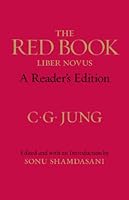
The Red Book
Liber Novus depicts Jung’s descent into Hell. But whereas Dante could utilize an established cosmology, Liber Novus is an attempt to shape an individual cosmology.
C. G. Jung • The Red Book
In 1918, Jung wrote a paper entitled “On the unconscious,” where he noted that all of us stood between two worlds: the world of external perception and the world of perception of the unconscious.
C. G. Jung • The Red Book
It happened in October of the year 1913 as I was leaving alone for a journey, that during the day I was suddenly overcome in broad daylight by a vision: I saw a terrible flood that covered all the northern and low-lying lands between the North Sea and the Alps. It reached from England up to Russia, and from the coast of the North Sea right up to
... See moreC. G. Jung • The Red Book
1913
With his seminars on Kundalini Yoga in 1932, Jung commenced a comparative study of esoteric practices, focusing on the spiritual exercises of Ignatius of Loyola, Patanjali’s Yoga sutras, Buddhist meditational practices, and medieval alchemy, which he presented in an extensive series of lectures at the Swiss Federal Institute of Technology (ETH).243
... See moreC. G. Jung • The Red Book
In the Black Books, Jung wrote down his fantasies in dated entries, together with reflections on his state of mind and his difficulties in comprehending the fantasies. The Black Books are not diaries of events, and very few dreams are noted in them. Rather, they are the records of an experiment. In December 1913, he referred to the first of the
... See moreC. G. Jung • The Red Book
Madness is a special form of the spirit and clings to all teachings and philosophies, but even more to daily life, since life itself is full of craziness and at bottom utterly illogical. Man strives toward reason only so that he can make rules for himself. Life itself has no rules. That is its mystery and its unknown law. What you call knowledge is
... See moreC. G. Jung • The Red Book
If you have still not learned this from the old holy books, then go there, drink the blood and eat the flesh of him who was mocked61 and tormented for the sake of our sins, so that you totally become his nature, deny his being-apart-from-you; you should be he himself, not Christians but Christ, otherwise you will be of no use to the coming God.
C. G. Jung • The Red Book
The chapters follow a particular format: they begin with the exposition of dramatic visual fantasies. In them Jung encounters a series of figures in various settings and enters into conversation with them. He is confronted with unexpected happenings and shocking statements. He then attempts to understand what had transpired, and to formulate the
... See moreC. G. Jung • The Red Book
how chapters of The Red Book are structured + mythopoetic imagination as missing part
He argued that individuation and collectivity were a pair of opposites related by guilt. Society demanded imitation. Through the process of imitation, one could gain access to values that were one’s own. In analysis, “Through imitation the patient learns individuation, because it reactivates his own values.”155 It is possible to read this as a
... See moreC. G. Jung • The Red Book
individuation vs collectivity